
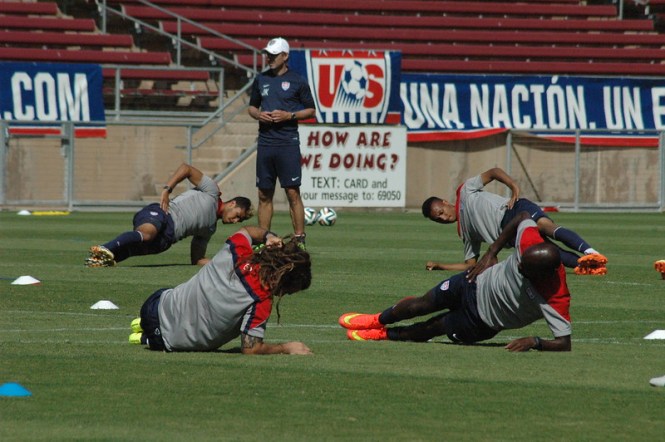
The U.S. National Team appears much more diverse on the field than it does on its executive board, a trait MLS and United Soccer Coaches also appear to follow. The men’s team (shown here warming up at Stanford University under the direction of head coach Jürgen Klinsmann — who won the 1990 World Cup playing for Germany — weeks before the 2014 Word Cup began in Brazil) made it all the way to the Round of 16 in 2014 before its brutalization by Belgium. The team did not qualify for the tournament in 2018. Some suggest that the lack of diversity and opportunity in American soccer is to blame for our lack of a World Cup trophy (from our men). Photo Credit: Rebecca Townsend
The Crack drops at a perfect time for honest exploration of race — and soccer
By Rebecca Townsend
Leave it to elite soccer players to understand timing.
Former U.S. Men’s National Team members DaMarcus Beasley and Oguchi “Guchi” Onyewu, and Futbolr Clothing‘s Mabricio “Mookie” Wilson, (a former collegiate player for Old Dominion University) have timed the debut of The Crack Podcast to drop in the midst of the national (and, truly, global) conversation about how to grapple with our racial demons.
Among the issues tackled in the Crack’s two-part series on racial injustice: the lack of black leadership at the top levels of the U.S. soccer business, on and off the field; the lack of follow-through among professional teams when it comes to cracking down on racist attacks on athletes; analysis of the Drew Brees apology for criticizing players who chose to kneel during the National Anthem, and an exploration of recent examples in which MLS clubs released employees embroiled in racially related scandals.
You Inspired So Many People, You Tools
The number of racial issues dogging the soccer world gave the hosts much meat for conversation. They supported the LA Galaxy in releasing Aleksander Katai after his wife posted violent and racist comments on social media.
But the overall performance of the MLS — and other top soccer groups — on racial awareness received heavy doses of criticsm.
After Columbus Crew SC’s Derrick Etienne experienced racial profiling and offensive comments during a traffic stop in Ohio, he issued a statement that said, in part, ““As American people we must put behind foolish and hateful stereotypes and accept all people the way God intended … by the content of our character not the color of our skin.”
The MLS issued a Tweet of solidarity.
We hear you. We see you. We support you.@detienne_10 💭
— Major League Soccer (@MLS) June 5, 2020
The Crack crew noted that the league’s gesture drew an incredulous response from Toronto FC striker and U.S. National Team player Jozy Altidore.
Do you? That lockout threat felt very real just a few days ago. You didn’t hear us, see us nor support us then. Hopefully this change of heart is here to stay and not a trend like most. Let’s do better @MLS https://t.co/URYWd0bzVz
— Jozy Altidore (@JozyAltidore) June 5, 2020
“He went right at the head of the dragon,” Beasley said. “It’s not just MLS. All these institutions are finally trying to see the light of what Kaepernick — and even Rapinoe — what they started a long time ago — and then for 100 or 200 years, what all black people have been trying to do.”
“If you don’t sit down and talk to the people who work for you, how will you see it from their eyes — your players, your team, your club, the people you write checks? If you don’t understand them as human beings?” — DaMarcus Beasley
In the entire MLS, the Crack crew could count two black coaches and two black general managers.
In addition, the boards of U.S. Soccer, United Soccer Coaches, U.S. Soccer Players Council and the MLS executive leadership team have no black representation. Calls in search of a response to or engagement with the issues raised by The Crack were not returned by United Soccer Coaches (despite the fact that the author of this piece is a past member) or the MLS. [This story will be updated if and when a response is secured.] A Tweet looking for input was also left ignored.
I’m writing an article based on a recent @thecrackpodcas1: Please confirm @mls, @unitedcoaches, @ussoccer (& affiliated players’ councils): Are there any black people @ your top leadership tiers? Also, is it 2black MLS GMs &2 black coaches? Owners? #justcurious #aimingforequity https://t.co/fNpPtjun2j
— Rebecca Townsend (@hoosierchild) June 20, 2020
Onyewu wondered if he “punked out” by not taking a knee during his last year playing in the MLS. He confessed worrying about might happen if he did. This is the exact same feeling Crystal Dunn reported having when she remained standing next to a kneeling Megan Rapinoe.
Worth reading this whole answer from the USWNT’s Crystal Dunn on Rapinoe kneeling in 2016. I remember people making a thing of the image of Dunn standing next to her.
“I’m scared for my job. I’m scared that it’s going to look different if a black girl on the team kneels.” pic.twitter.com/jE2jt3ePrS
— Molly Hensley-Clancy (@mollyhc) June 16, 2020
“I think it’s a bold move from Jozy,” Onyewu said. “I agree wholeheartedly. If MLS is gonna make that announcement or declaration, they have to back it up. Up until now, they really haven’t backed it up, if I’m gonna be honest.
“…The disproportionate number of black representatives at higher positions in the MLS right now, whether it be head coaches, whether it be management. …There are a number of qualified black coaches that would love the opportunity but haven’t been given the opportunity. And what’s the reason?”
Wilson interjected: “The same coaches they’ve been recycling since the beginning of the league.”
Onyewu proceeded to say he doesn’t blame the people who are working for taking the positions offered them, but he went on to name several players without coaching experience who went directly from playing into a directorial role in the top levels of U.S. soccer with no prior experience beyond their playing careers.
“How many first-team, retiring black players have gotten the opportunity?” he asked.
Beasley replied,” Not me. My phone is silent.”
An incredulous Onyewu asked, “Beas, with just our situations: Beas, 4-time World Cup, only player to be in 5 World Cup cycles, has won over 17 titles in his career. Never been contacted. But they give other people they give opportunities.”
When he retired, Onyewu said he was told, ‘We love you. Not enough experience.’ I’m like, ‘Hold up! I’m college educated. I own and operate three businesses. Speak three languages. Have a vast international contact network and this is on top of my playing career! (The crew dissolves into laughter over how ridiculous it all seems.) But I’m underqualified? If I’m underqualified, what are these other people before me?!”
He added, “As black men, I often feel we must be twice as good to get the same type of positions.” And he challenged white listeners to ask both black and white people if their parents told them they’d have to work twice as hard to have an equal shot at anything.
“Why?” he concluded. “This my question to the MLS: If you hear us, if you see us, if you are with us, why don’t your actions show that?”
Wilson offered a heartfelt and action-oriented response.
“What they have told us by doing nothing is: this is not for us. We’re here to be workers. We’re not here to lead. We’re not here to supervise. We’re not here to own. It’s plain and simple as that. We have a pyramid and a coaching structure and no one gets elevated.” — Maubricio Wilson
“The equal tears, work and sweat you put in with your teammates is never considered as good … It’s a thank you, appreciate it … keep on moving… See ya when I see ya!” Wilson said. “Both you guys have been disrespected and treated differently from day one of your campaign with the U.S. soccer team. …The time is now not to kick and scream but to be intelligent enough to say, ‘Listen, we’re not moving forward until we have representation at the top because if we don’t have that, nothing else matters. …At the top, if we don’t have someone there, they will always reject it [black efforts to participate] or continue to put their filter on it. That’s what they want to continue to do. You know why? They must be scared of us. They must be scared because of how they treated us in the past, they think we’re gonna do the same to them.
“That’s the only answer I have, Guic, when you ask me ‘Why? Why do they treat us the way they treat us?’
“As a fan outside looking at you two, you got through and made it. I’m so proud of you two, you inspired so many people: black, white, Spanish, Asian, it doesn’t matter. But throughout the process, you were always just a tool. You were never given your just due or given fair treatment. I’m tired of begging or asking, right? I think we’ve got to mobilize and take it. That’s the only thing they’re going to respect.” — Maubricio Wilson
Onyewu snickered with Beasley about Wilson’s “militant” tone.
“It’s not militant,” Wilson replied. “I like to say: intelligent. Why keep running and hitting the wall if you know what the result is going to be?”
Hit ‘em Up with Ricci Greenwood: Analyzing the case of Alan Hinton
Speaking of the notion of being a tool for others to use, the Crack also weighed in on the degree to which enigmatic Tweets from Seattle soccer legend reflected a racist tone.
Alan Hinton. White boots. Baseball Ground. Bald players. Perfect. Derby 5 Arsenal 0 1972 #dcfc @alanhinton11 @Rams_Chat @dcfcofficial pic.twitter.com/ZVCz2zZxii
— @forgottengoals (@forgottengoals) May 6, 2017
Alan Hinton, a 77-year old former pro player from Derby County who played with (and won two league titles with) one of the first racially mixed teams in England — also former Seattle Sounder coach, who won titles for the team in 1995 and 1996, lost his contract as a Sounders “brand ambassador” as a result of this Tweet to more than 10,000 followers:
“Let me make clear I am not a racist? I began in pro soccer when no black players on my team? Years later blacks started to be good so my attitude was ‘Love you if you help us win our bonuses’? Signed as a coach several good black players? Have friends who are black? Is that OK?”
The Seattle Times reported in 2019 that “his use of question marks was initially an error when he established his Twitter account in 2011,” a “running joke” he kept going.
The Crack crew was mystified by the question marks but also miffed at the all-too-familiar feeling that people don’t mind integrating if it means winning and bonuses.
“We find a lot of people in power who will recruit an African American if it helps them win, but not necessarily have the best intentions for the African-American culture,” Wilson commented.
Also, Hinton had unconsciously used language that often throws up a red flag to black listeners.
Beasley explained, “One thing all of us as black men always say … whenever someone makes the comment, ‘I have black friends,’ what does that mean?”
Onyewu answered: “He a damn racist.”
The Crack is a well-sourced bunch, however. And they were not content to cast judgment from the sidelines without more first-hand knowledge. So they called their friend Ricci Greenwood, a Seattle kid turned MLS player and international pro, who Hinton nurtured as a young player.

Seattle native Ricci Greenwood played for the Columbus Crew and 1. FC Nürnberg during his prime. He credits Alan Hinton’s direction with helping him through tough issues as a young soccer player. Photo credit to Fedophile44 via Wikipedia Public Domain
“Alan is not a racist,” Greenwood said. “[The Tweet] didn’t sound right, but on a personal side and the things he did for me, I know he’s not.
“I think he was trying to bridge two different times…
“I just go off the experiences I had with him. From my point of view. He was one of few coaches who even took the time. We broke bread and had breakfast, lunch, and dinner; and he told me a lot of things that were very profound for me. Alan is an older white man from Britain. His statements were taken out of context and then everyone was rushing to turn their backs on him. He’s an icon here and they were quick to pass judgment.
Greenwood continued: “I had tears. I didn’t want to play anymore. Everyone was a racist. He was the only person who reached out and would hear about the anger I had. … All these great coaches were quick to label me uncoachable … that never came from him.
“His statements don’t match the man I know (even as his) statements were targeting African-American players in the wrong light. We should be open to make sure that people learn and understand how this is offensive to some people and kind of help them and correct them. But don’t crucify him and turn your back on him. I feel he’s a person that could learn from this and learn a lot.”
Soccer connections enable frontline insight on police perspective

One of many makeshift memorials left in the wake of worldwide protests decrying police brutality and systematic racism. [Photo by Rebecca Townsend]
Stueckenschneid recounted the experience of watching the video of George Floyd’s killing with some fellow NYPD officers.
“It was very disturbing to watch this happen to another human being,” Stueckenschneid said. “We’re in this profession, like: What’s going on? What was this guy thinking? It’s disturbing and it has to be addressed. They lost their jobs, fine. That’s minimal. One guy’s gettin’ locked up. He’s gonna do a serious bit of time. Probably 25-to-life.”
Wilson interjects: “But history has shown, coach, usually they don’t get convicted.”
Stueckenschneid responds: “Well, there’s video on this, ok? There is public outcry.”
Wilson also queried Stueckenschneid on what he thought would happen to the other three cops who stood around while Officer Derek Chauvin killed Floyd: “What about the other cops? I hear “We take care of our own.” What is going on with the other three cops? Why are the other three cops not being held accountable?”
“The investigation into those three guys is still ongoing,” he responded, noting the FBI’s Civil Rights Division is a notorious enforcer, as NYPD itself learned in the case of Abner Louima. “They have infinite resources and nothing but time. It might take a while… but they’re gonna get got …There will be something there.”
Stueckenschneid also questioned the whereabouts of Chauvin’s commanding officer, noting that in New York, he is held accountable for all the officers operating underneath him. He also noted that cops must help other cops cool down in tense situations.
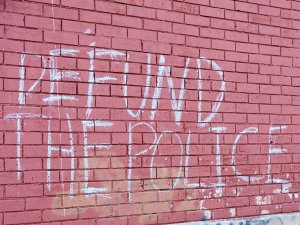
Calls to “Defund the Police” reflect protestors’ vision of a revamped public safety landscape. [Photo taken in Downtown Bloomington, Indiana, June 2020 by Rebecca Townsend.]
“I’m sure that’s where we’ll be headed,” Stueckenschneid said. “This is not a unique incident only to Minneapolis. It’s been nationwide. We’ve had situations in New York that were very ugly: Eric Gardner, Abner Louima.”
Before concluding the conversation, the men brought it back to the international art form of talking smack about soccer and were laughing together as they said their fare-thee-wells.
After releasing Stueckenschneid from the line, Wilson asked his friends what they thought of the conversation.
“It was informative and an interesting conversation,” Beasley said. “I think it was great to hear his perspective on things. For getting a sense of what they go through, talk about and how they think about different things in different circumstances.”
In terms of envisioning how to move forward on the issue of police brutality and racial inequality, Onyewu said, “It’s about creating a new America. It’s hard to go back and change multiple centuries of thought, action and habit, but it’s not that difficult to pivot.
“I think we’re at a crucial moment. This is an opportunity for humanity…. As a global community, this is a great opportunity to pivot and say, “…This won’t continue anymore! I won’t stand for it!”

This Jimi Hendrix quote, chalked on an Indiana sidewalk during worldwide protests, continues to inspire higher thinking decades after the guitar hero’s death. “When the power of love overcomes the love of power, the world will know peace.” [Photo credit: Rebecca Townsend]

 Hoosier Shangrila