Do Black Lives Matter in Soccer?

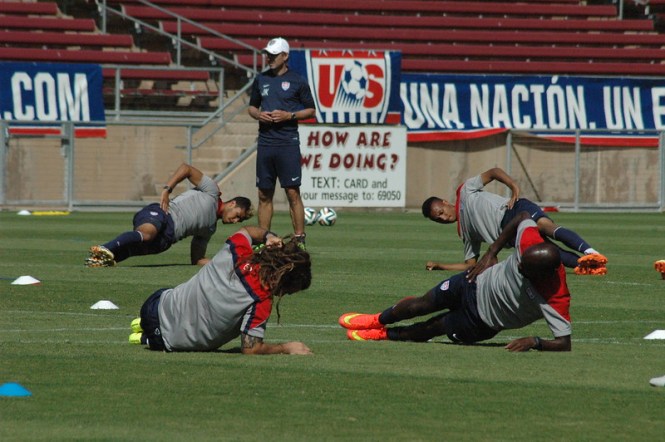
National Team warms up with

The U.S. National Team appears much more diverse on the field than it does on its executive board, a trait MLS and United Soccer Coaches also appear to follow. The men’s team (shown here warming up at Stanford University under the direction of head coach Jürgen Klinsmann — who won the 1990 World Cup playing for Germany — weeks before the 2014 Word Cup began in Brazil) made it all the way to the Round of 16 in 2014 before its brutalization by Belgium. The team did not qualify for the tournament in 2018. Some suggest that the lack of diversity and opportunity in American soccer is to blame for our lack of a World Cup trophy (from our men). Photo Credit: Rebecca Townsend


The Crack drops at a perfect time for honest exploration of race — and soccer

By Rebecca Townsend

Leave it to elite soccer players to understand timing. 

Former U.S. Men’s National Team members DaMarcus Beasley and Oguchi “Guchi” Onyewu, and Futbolr Clothing‘s Mabricio “Mookie” Wilson, (a former collegiate player for Old Dominion University) have timed the debut of The Crack Podcast to drop in the midst of the national (and, truly, global) conversation about how to grapple with our racial demons. 

Among the issues tackled in the Crack’s two-part series on racial injustice: the lack of black leadership at the top levels of the U.S. soccer business, on and off the field; the lack of follow-through among professional teams when it comes to cracking down on racist attacks on athletes; analysis of the Drew Brees apology for criticizing players who chose to kneel during the National Anthem, and an exploration of recent examples in which MLS clubs released employees embroiled in racially related scandals.

You Inspired So Many People, You Tools

The number of racial issues dogging the soccer world gave the hosts much meat for conversation. They supported the LA Galaxy in releasing Aleksander Katai after his wife posted violent and racist comments on social media.

But the overall performance of the MLS — and other top soccer groups — on racial awareness received heavy doses of criticsm. 

After Columbus Crew SC’s Derrick Etienne experienced racial profiling and offensive comments during a traffic stop in Ohio, he issued a statement that said, in part, ““As American people we must put behind foolish and hateful stereotypes and accept all people the way God intended … by the content of our character not the color of our skin.”

The MLS issued a Tweet of solidarity.

The Crack crew noted that the league’s gesture drew an incredulous response from Toronto FC striker and U.S. National Team player Jozy Altidore.


He went right at the head of the dragon,” Beasley said. “It’s not just MLS. All these institutions are finally trying to see the light of what Kaepernick — and even Rapinoe — what they started a long time ago — and then for 100 or 200 years, what all black people have been trying to do.”

“If you don’t sit down and talk to the people who work for you, how will you see it from their eyes  — your players, your team, your club, the people you write checks? If you don’t understand them as human beings?” — DaMarcus Beasley

In the entire MLS, the Crack crew could count two black coaches and two black general managers.

In addition, the boards of U.S. Soccer, United Soccer Coaches, U.S. Soccer Players Council and the MLS executive leadership team have no black representation. Calls in search of a response to or engagement with the issues raised by The Crack were not returned by United Soccer Coaches (despite the fact that the author of this piece is a past member) or the MLS. [This story will be updated if and when a response is secured.] A Tweet looking for input was also left ignored.

Onyewu wondered if he “punked out” by not taking a knee during his last year playing in the MLS. He confessed worrying about might happen if he did. This is the exact same feeling Crystal Dunn reported having when she remained standing next to a kneeling Megan Rapinoe.

“I think it’s a bold move from Jozy,” Onyewu said. “I agree wholeheartedly. If MLS is gonna make that announcement or declaration, they have to back it up. Up until now, they really haven’t backed it up, if I’m gonna be honest.

“…The disproportionate number of black representatives at higher positions in the MLS right now, whether it be head coaches, whether it be management. …There are a number of qualified black coaches that would love the opportunity but haven’t been given the opportunity. And what’s the reason?”

Wilson interjected: “The same coaches they’ve been recycling since the beginning of the league.”

Onyewu proceeded to say he doesn’t blame the people who are working for taking the positions offered them, but he went on to name several players without coaching experience who went directly from playing into a directorial role in the top levels of U.S. soccer with no prior experience beyond their playing careers. 

“How many first-team, retiring black players have gotten the opportunity?” he asked.

Beasley replied,” Not me. My phone is silent.”

An incredulous Onyewu asked, “Beas, with just our situations: Beas, 4-time World Cup, only player to be in 5 World Cup cycles, has won over 17 titles in his career. Never been contacted. But they give other people they give opportunities.”

When he retired, Onyewu said he was told, ‘We love you. Not enough experience.’ I’m like, ‘Hold up! I’m college educated. I own and operate three businesses. Speak three languages. Have a vast international contact network and this is on top of my playing career! (The crew dissolves into laughter over how ridiculous it all seems.) But I’m underqualified? If I’m underqualified, what are these other people before me?!”

He added, “As black men, I often feel we must be twice as good to get the same type of positions.” And he challenged white listeners to ask both black and white people if their parents told them they’d have to work twice as hard to have an equal shot at anything.

“Why?” he concluded. “This my question to the MLS: If you hear us, if you see us, if you are with us, why don’t your actions show that?”

Wilson offered a heartfelt and action-oriented response.

“What they have told us by doing nothing is: this is not for us. We’re here to be workers. We’re not here to lead. We’re not here to supervise. We’re not here to own. It’s plain and simple as that. We have a pyramid and a coaching structure and no one gets elevated.” — Maubricio Wilson

“The equal tears, work and sweat you put in with your teammates is never considered as good … It’s a thank you, appreciate it … keep on moving… See ya when I see ya!” Wilson said. “Both you guys have been disrespected and treated differently from day one of your campaign with the U.S. soccer team. …The time is now not to kick and scream but to be intelligent enough to say, ‘Listen, we’re not moving forward until we have representation at the top because if we don’t have that, nothing else matters. …At the top, if we don’t have someone there, they will always reject it [black efforts to participate] or continue to put their filter on it. That’s what they want to continue to do. You know why? They must be scared of us. They must be scared because of how they treated us in the past, they think we’re gonna do the same to them.

“That’s the only answer I have, Guic, when you ask me ‘Why? Why do they treat us the way they treat us?’

“As a fan outside looking at you two, you got through and made it. I’m so proud of you two, you inspired so many people: black, white, Spanish, Asian, it doesn’t matter. But throughout the process, you were always just a tool. You were never given your just due or given fair treatment. I’m tired of begging or asking, right? I think we’ve got to mobilize and take it. That’s the only thing they’re going to respect.” — Maubricio Wilson

Onyewu snickered with Beasley about Wilson’s “militant” tone.

“It’s not militant,” Wilson replied. “I like to say: intelligent. Why keep running and hitting the wall if you know what the result is going to be?”

Hit ‘em Up with Ricci Greenwood: Analyzing the case of Alan Hinton 

Speaking of the notion of being a tool for others to use, the Crack also weighed in on the degree to which enigmatic Tweets from Seattle soccer legend reflected a racist tone.

Alan Hinton, a 77-year old former pro player from Derby County who played with (and won two league titles with) one of the first racially mixed teams in England — also former Seattle Sounder coach, who won titles for the team in 1995 and 1996, lost his contract as a Sounders “brand ambassador” as a result of this Tweet to more than 10,000 followers:

“Let me make clear I am not a racist? I began in pro soccer when no black players on my team? Years later blacks started to be good so my attitude was ‘Love you if you help us win our bonuses’? Signed as a coach several good black players? Have friends who are black? Is that OK?”

The Seattle Times reported in 2019 that “his use of question marks was initially an error when he established his Twitter account in 2011,” a “running joke” he kept going.

The Crack crew was mystified by the question marks but also miffed at the all-too-familiar feeling that people don’t mind integrating if it means winning and bonuses.

“We find a lot of people in power who will recruit an African American if it helps them win, but not necessarily have the best intentions for the African-American culture,” Wilson commented.

Also, Hinton had unconsciously used language that often throws up a red flag to black listeners.

Beasley explained, “One thing all of us as black men always say … whenever someone makes the comment, ‘I have black friends,’ what does that mean?”

Onyewu answered: “He a damn racist.”

The Crack is a well-sourced bunch, however. And they were not content to cast judgment from the sidelines without more first-hand knowledge. So they called their friend Ricci Greenwood, a Seattle kid turned MLS player and international pro, who Hinton nurtured as a young player.

RicciGreenwoodbyFedophile44viawikipedia

Seattle native Ricci Greenwood played for the Columbus Crew and 1. FC Nürnberg during his prime. He credits Alan Hinton’s direction with helping him through tough issues as a young soccer player. Photo credit to Fedophile44 via Wikipedia Public Domain

“Alan is not a racist,” Greenwood said. “[The Tweet] didn’t sound right, but on a personal side and the things he did for me, I know he’s not.

“I think he was trying to bridge two different times…

“I just go off the experiences I had with him. From my point of view. He was one of few coaches who even took the time. We broke bread and had breakfast, lunch, and dinner; and he told me a lot of things that were very profound for me. Alan is an older white man from Britain. His statements were taken out of context and then everyone was rushing to turn their backs on him. He’s an icon here and they were quick to pass judgment.

Greenwood continued: “I had tears. I didn’t want to play anymore. Everyone was a racist. He was the only person who reached out and would hear about the anger I had. … All these great coaches were quick to label me uncoachable … that never came from him.

“His statements don’t match the man I know (even as his) statements were targeting African-American players in the wrong light. We should be open to make sure that people learn and understand how this is offensive to some people and kind of help them and correct them. But don’t crucify him and turn your back on him. I feel he’s a person that could learn from this and learn a lot.”

Soccer connections enable frontline insight on police perspective

In Memorial ...

One of many makeshift memorials left in the wake of worldwide protests decrying police brutality and systematic racism. [Photo by Rebecca Townsend]

As the battle cry of “Fuck 12” echoed nationwide, the Crack crew (who are all black, by the way) spoke with Jon Stueckenschneid, a white cop, who also happens to be a soccer coach. In terms of perspective, the crew couldn’t have found someone more qualified to weigh in from a police leadership perspective. Stueckenschneid said has worked the streets and subways of New York since he began policing in the late ‘90s. He currently commands the Queens division. Somehow the soccer bond allowed the conversation to get deep even among the minefields of tribalism that threatens to lock people in impenetrable camps of “us versus them,” “cops versus citizens” and “white versus black.” 

Stueckenschneid recounted the experience of watching the video of George Floyd’s killing with some fellow NYPD officers.

“It was very disturbing to watch this happen to another human being,” Stueckenschneid said. “We’re in this profession, like: What’s going on? What was this guy thinking? It’s disturbing and it has to be addressed. They lost their jobs, fine. That’s minimal. One guy’s gettin’ locked up. He’s gonna do a serious bit of time. Probably 25-to-life.”

Wilson interjects: “But history has shown, coach, usually they don’t get convicted.”

Stueckenschneid responds: “Well, there’s video on this, ok? There is public outcry.”

Wilson also queried Stueckenschneid on what he thought would happen to the other three cops who stood around while Officer Derek Chauvin killed Floyd: “What about the other cops? I hear “We take care of our own.” What is going on with the other three cops? Why are the other three cops not being held accountable?”

“The investigation into those three guys is still ongoing,” he responded, noting the FBI’s Civil Rights Division is a notorious enforcer, as NYPD itself learned in the case of Abner Louima. “They have infinite resources and nothing but time. It might take a while… but they’re gonna get got …There will be something there.”

Stueckenschneid also questioned the whereabouts of Chauvin’s commanding officer, noting that in New York, he is held accountable for all the officers operating underneath him. He also noted that cops must help other cops cool down in tense situations.

20200613_2018218399633431409852856.jpg

Calls to “Defund the Police” reflect protestors’ vision of a revamped public safety landscape. [Photo taken in Downtown Bloomington, Indiana, June 2020 by Rebecca Townsend.]

Onyewu asked whether a nationwide standard of policing would help.

“I’m sure that’s where we’ll be headed,” Stueckenschneid said. “This is not a unique incident only to Minneapolis. It’s been nationwide. We’ve had situations in New York that were very ugly: Eric Gardner, Abner Louima.”

Before concluding the conversation, the men brought it back to the international art form of talking smack about soccer and were laughing together as they said their fare-thee-wells.

After releasing Stueckenschneid from the line, Wilson asked his friends what they thought of the conversation.

“It was informative and an interesting conversation,” Beasley said. “I think it was great to hear his perspective on things. For getting a sense of what they go through, talk about and how they think about different things in different circumstances.”

In terms of envisioning how to move forward on the issue of police brutality and racial inequality, Onyewu said, “It’s about creating a new America. It’s hard to go back and change multiple centuries of thought, action and habit, but it’s not that difficult to pivot.

“I think we’re at a crucial moment. This is an opportunity for humanity…. As a global community, this is a great opportunity to pivot and say, “…This won’t continue anymore! I won’t stand for it!”

20200613_202134583068474576145993.jpg

This Jimi Hendrix quote, chalked on an Indiana sidewalk during worldwide protests, continues to inspire higher thinking decades after the guitar hero’s death. “When the power of love overcomes the love of power, the world will know peace.” [Photo credit: Rebecca Townsend]

 

Peter Wilt’s December Debriefing

Indy Eleven President and GM joined Townsend this summer in her hometown of Bloomington, Indiana, to catch Indiana University host Wilt's alma mater Marquette University.

Indy Eleven President and GM joined Townsend last August in her hometown of Bloomington, Indiana, to catch Indiana University host Wilt’s alma mater Marquette University. The match went 1-0 in the Hoosier’s favor, though the Golden Eagles pitched a hard-fought battle and were, in Townsend’s opinion denied a penalty kick when the ref missed a last-minute Hoosiers error in the penalty box.

Though it’s taken mainstream media some time to really “get” the story, reporter (and lifelong soccer junkie) Rebecca Townsend has been on Peter Wilt and the Indy Eleven since the beginning. She and Wilt first met in November 2012 and taped their first interview on the steps of the Indiana War Memorial in December of 2012,  discussing his intention to help start a pro soccer team in Indianapolis.

In December 2014 at the Elbow Room, a pub just steps away from the memorial, Townsend and Wilt reconnected to reflect on all that’s happened since their last 2013 December debriefing: Dozens of amazing soccer games in Downtown Indianapolis, the best fan attendance in the North American Soccer League — better, even, than many larger-market Major League Soccer Teams, the league’s longest-running shutout record (in terms of minutes played without a goal scored) and two huge wins to wind out the season. [Now comes the huge roster shakeup and less than 100 days till the opening of spring season.]

The following is edited for clarity and length [though it is still massive, especially by today’s standards]:

Rebecca: I love this time of year because it reminds me of when you first came to town.

Peter: Two years and two months.

Rebecca: What are some of the things you learned in 2014?

Peter: In a way it’s like opening a present and finding out what’s inside it. But it’s more than that because that would be a total unknown. We knew we were building something. We spent a year working with so many partners to create something, not quite knowing what it would be, having some expectations. This year has been an amazing unveiling of … I apologize for the triteness, but it’s the fruits of the labor. Not just of the front office, but of everyone we’ve partnered with.

The success results from the contributions of everyone involved. The easy part is looking at the numbers and selling out the game, and how many tickets sold and how many people went to the game. But really the success to me is the depth of emotional connection, of the passion that people in the community have for this team.  …It wasn’t necessarily work, it was just working with people, talking to people, negotiating and then promoting.. getting people excited.

Seeing that people did get excited, that to me is the ultimate result of it.

It wasn’t just that 10,000 people bought tickets to every game. It’s that the people that did come to the games loved it and they cared about it.  

If we lost it hurt them. It’s weird to say, but: That’s good. It’s good they were pained; that means they cared. The worst thing is apathy. I don’t I think there was much apathy for this team and this organization and that bodes well for the future.

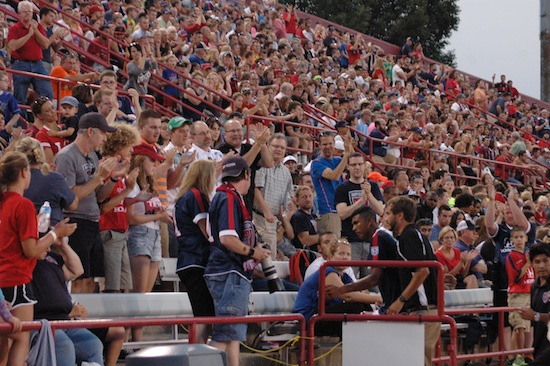
Indy fans offer Sergio Peña a standing ovation as he leaves the field following a dubious red card. Rebecca Townsend

Indy fans offer Sergio Peña a standing ovation as he leaves the field following a dubious red card during Indy’s hard-fought 2-3 loss to the Atlanta Silverbacks in August. Rebecca Townsend

Rebecca: Let’s talk about expectations going into the season and think about how that played out.

Peter: I expected we were gonna win.

Rebecca: Did you, really honestly expect that we were going to win in the beginning? 

Peter: Yes! I thought New York was going to be the only team better than us. They were better than us. But there were a few others that were also better than us. 

Rebecca: How can a man that knows so much about soccer be so wrong? 

Peter: Two things: I underestimated the rest of the league and I overestimated our team, especially our defense. Our back line was awful. Every game we were giving up the first goal and it was often an early goal and we were chasing the game and our attacking options weren’t that great either. We weren’t as good as I thought we were.

Rebecca: Do you think Juergen was more realistic about the building process?

 Peter: Yeah! Juergen throughout the whole process tried to set expectations — and set low expectations — and I wanted none of it.

Rebecca: It seems you guys may have found a happy medium in the end. We lost a lot but toward the end of the season, we pulled out some amazing …

Peter: We fixed the defense by signing Cory Miller.

Rebecca: It’s important to note, though, that we still have a lot of the key elements of that defensive line that was supposedly so problematic in the beginning: We still have Jaimi, Eric, Kyle…

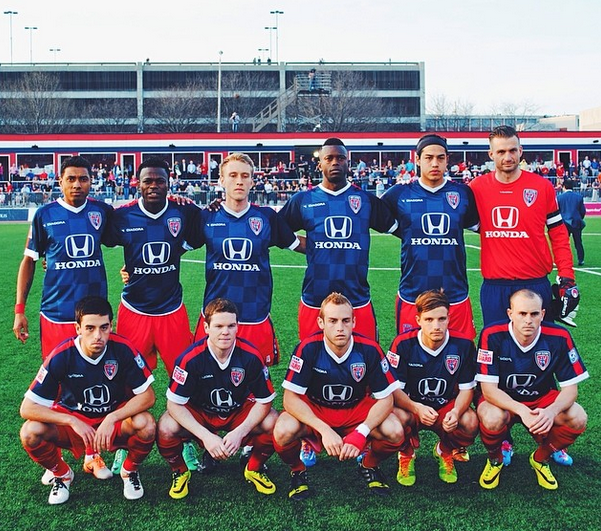
Indy's first starting line-up. From Lower Left: AJ Corrado, Mike Ambersley, Kyle Highland, Corby Moore and Chris Estridge. Upper row, from left: Kléberson, Walter Ramirez, Brad Ring, Erick Norales, Jaimi Frias and Kristian Nicht.

Indy’s first starting line-up. From Lower Left: AJ Corrado, Mike Ambersley, Kyle Highland, Corby Moore and Chris Estridge. Upper row, from left: Kléberson, Walter Ramirez, Brad Ring, Erick Norales, Jaimi Frias and Kristian Nicht. Norales, Frias, Nicht and Hyland remain key elements of the D, as will Brad Ring, who often pops in from a defensive mid position to help cull impending threats on the back third of the field. With the late-season addition of Cory Miller and the post-season signing of Greg Janicki, who won the 2014 NASL championship as a member of the San Antonio Scorpions, Indy’s defense continues to build.

Peter: Moving forward, the back line is the best it’s ever been for us. We’re in good shape with that. Our attacking options we fixed at the end of the year, but now they’re gone because we couldn’t afford them. They’re either too old or too hurt.

 We hope we could get Charlie Rugg back, which would be huge.

And we have the money now to go sign a couple more forwards.

We couldn’t afford Jhulliam. His option is at a stupid high option number.

Couldn’t afford or want Jermaine [Johnson]: His option number higher, health bad. Other issues.

Mike Ambersley: His option number was high – his age is getting up. We have concerns about his productivity. You don’t want to pay a player for what he’s done in the past. Like stocks: past performance not necessarily indicator of future performance. Mike Ambersley served a really important role for us last year. But he’s not the answer to scoring goals directly himself and his age and is health are question going forward. The cost of his contract was higher, so we decided to go in a different direction. Now it’s a matter of finding the right players.

Mike Ambersley (center) being choked by an Atlanta Silverbacks defender.

Mike Ambersley (center) being choked by an Atlanta Silverbacks defender. Ambersley took A LOT of punishment on behalf of the team throughout 2014 — he truly left it all on the field in his pursuit of goals. He scored six times for the club last season. (Photo by R. Townsend)

Rebecca: Was Mike the most difficult decision?

Peter: Mike and Jermaine were the two most difficult ones. By far.

Jhulliam, as good as he is, was not a difficult decision because of the option price was ridiculously high. We couldn’t sign four or five other players. Jhulliam might come back and say he couldn’t get a better deal — his age is good, his talent is good — we’d love to have him on the team — his attitude. All of  that is good, but it’s just the money …

Rebecca: How much wiggle room do you get because it is Indy? Does the soccer enthusiasm trade in for players being willing to maybe take less but be involved with more?

Peter: That’s helping us. A number of players and agents are calling us saying their players love playing in Indy. Would love to play here all the time. That absolutely helps — it expand the pool of talent.

Also, last year I don’t think we has enough players with experience in this league. This is a unique league, as any league is … You need players that know what it’s about to be successful in this league: what the training is like, what the travel is like, what the opponents are like …  We had two players with significant experience in this league: Mike Ambersley and Pedro Mendes (gone after spring season for “a number of reasons”) .. most teams have five times that number of players. I think that was problematic.

Now, in theory, everyone we’re bringing back has experience in this league. We’re recruiting players in this league who have been successful in this league who like what they see in Indy.

 Rebecca: What’s so different about playing in this league?

 Peter: It’s a physical league and the travel is hard.

 Rebecca: More so than others?

 Peter: Any league in the world except for Russia — and in major league soccer — has less travel. This is the third-hardest league in the world from a travel perspective. In England, half your games are in two hours. … Frankly the training conditions, the locker rooms – this is a hard league. And on the field very physical..

Rebecca: Because people are trying to make their names, right? This is where you either make it or you don’t?

Peter: Well they’re trying to do this throughout the world. But the nature of American players, they are not as technical as in Latin America or Europe or Africa — they’re making it on their physical muscle and it’s hard. It’s different. And players who may be successful in different systems, aren’t necessarily successful in this one.

Rebecca: In terms of thinking of soccer as a business, but also passion-driven: How do you have find that balance between business logic and breeding loyalty where everyone is all-in …

Peter: It’s all at the end of the day business. Winning games is good business. It’s about winning. What goes into winning isn’t purely physical skills. It’s also about character, work rate, selflessness — characteristics that help a team win.

You might be the greatest player in the world in terms of physical qualities, but there is also character, mental tactical aspects of your makeup as well. And I don’t think we had the best balance of those characteristics in the spring season. We improved it in the fall season, but we’re still not perfect. I don’t think we have as much quality on the leadership aspect as a winning team needs to have.

That doesn’t mean we don’t have good guys …

Brazilian World Cup Champ Kléberson netted 5 penalty goals for Indy Eleven in its inaugural 2014 season.

Brazilian World Cup Champ Kléberson netted 5 penalty goals for Indy Eleven in its inaugural 2014 season.

Take a player like Kléberson … Fantastic player, fantastic guy, good character, but he’s not a traditional leader, he’s not a vocal leader. Even throwing aside the language barrier, it’s not in his personality to be an outgoing leader. He leads by example, and that’s excellent, but this team needs more players with the personality to be outgoing leaders.

Rebecca: Kristian, who is very vocal, felt like he wasn’t filling that leadership role, as well. So, yet to be determined on who will be the heart of the team to drive it forward?

Maybe leadership is the answer. I want to be more specific on that question. If love and loyalty are important to making players hit the top of their potential for their team .. but yet everyone is a professional who knows this is business and may hinge on statistics at the end of a season that may not value selflessness … How do you get those important qualities, that love and loyalty in an environment that is, on its face, business?

Peter: Get to know players before you sign them that have those positive qualities.

When you’re assessing a player, it’s about all that. You recognize that not every player is going to have positive check marks in each of those areas, but you want to minimize the negative checkmarks and maximize the positive ones.

Rebecca: For players not from Indiana, how do we make them care about Indiana more than anywhere else they’ve been and want to perform?

Peter: I think the fans have done that. Any player that played for us last year loves the fans and loves the atmosphere they created. That part is are good as it can get. But not all the players were either good enough or strong-minded enough. So, obviously we’re making changes. You’re going to have some turnover for the very best of teams. The Galaxy’s season ended two days ago with a championship. A week from now, they’ll have at least six openings — on a championship team, including Landon Donovan. And that’s the best of teams. Those that finish near the bottom, like us, it’s going to be more than six and maybe a dozen.

We renewed eight contracts. We’ll end up re-signing two or three more than that — maybe 11. Then we’ll have another dozen or so new signings.  … Two new backup goalkeepers ..

Hopefully they’ll challenge Kristian and make him perform better and maybe even perform well themselves.

From left: Nathan Sprenkel, Jon Dawson and Kristian Nicht. Sprenkel and Dawsom helped stock local support for the team, Sprenkel as a DePauw University alum and Dawson of Butler.

From left: Nathan Sprenkel, Jon Dawson and Kristian Nicht. Sprenkel and Dawsom helped stock local support for the team, Sprenkel as a DePauw University alum and Dawson of Butler.

Rebecca: Can you tell me what happened with the goalies? When I saw them in practice, they seemed to be working. They were stopping the ball when it came their way. They looked committed to their training.

Peter: The coaches’ assessment was they weren’t pushing Kristian enough.

Rebecca: I don’t know how you push Kristian more because when Kristian Nicht should sit his butt on the bench because he can’t stand up straight because he’s got heat stroke, nobody ever pulled him off to give anyone else a chance.

I don’t know… He’s German. He doesn’t sit down. He doesn’t stop until he’s dead.

Indy Eleven's first player employee Kristian Nicht is a  veteran of Germany's elite Bundesliga. The 6' 4', 224-pound, 32-year-old played 2,430 minutes for Indy Eleven in 2014.

Indy Eleven’s first player employee Kristian Nicht is a veteran of Germany’s elite Bundesliga. The 6′ 4′, 224-pound, 32-year-old played 2,430 minutes for Indy Eleven in 2014.

Peter: The other goal keepers had chances in friendlies. They didn’t perform up to the standards the coaches held for them.

Rebecca: That’s too bad, but I guess that’s the way it is. I didn’t see those games, I guess. I just saw them sitting on the bench and working hard in practice. How did everybody take it?

Peter: Understanding it’s part of the business. There’s good communication throughout the year with the coaches and the players. They know where they stand. Frankly, it’s easier to let go of players after a bad year than after a good year. All you have to do is point to the standings and say: You were part of this, and it didn’t work out so well. Including myself.

Rebecca: Yeah, you and Juergen. My expectations were like yours … but maybe there are some realities Juergen can help us understand better about how to grow.

Peter: By making changes to the players, that doesn’t mean we’re absolving ourselves from responsibility. We’re part of it, including the players we kept. They are part of the responsibility of our failings.

Rebecca: How do you and Juergen communicate about the games?

Peter: First I have to watch the game, if it’s a home game i haven’t seen the whole game … I’ll either sit down with Juergen or talk to him on the phone. We’ll go through the pluses and the minuses. Usually after the game I go back to the locker room for a debriefing, we go through the individuals, what went well, what didn’t… I get out to practice at least once a week. Maybe twice. Watch and talk. We are bombarded everyday with player applications or agents that want to come in. We talk about those everyday. We’re always trying to improve the team.


"Dragan Stojkov in action while playing for FK Jagodina 2014-01-28 19-13" by Own work. Licensed under CC BY-SA 3.0 via Wikimedia Commons - http://commons.wikimedia.org/wiki/File:Dragan_Stojkov_in_action_while_playing_for_FK_Jagodina_2014-01-28_19-13.JPG#mediaviewer/File:Dragan_Stojkov_in_action_while_playing_for_FK_Jagodina_2014-01-28_19-13.JPG

“Dragan Stojkov in action while playing for FK Jagodina 2014-01-28 19-13” by Own work. Licensed under CC BY-SA 3.0 via Wikimedia Commons – http://commons.wikimedia.org/wiki/File:Dragan_Stojkov_in_action_while_playing_for_FK_Jagodina_2014-01-28_19-13.JPG#mediaviewer/File:Dragan_Stojkov_in_action_while_playing_for_FK_Jagodina_2014-01-28_19-13.JPG


Rebecca: How did you find Dragan Stojkov, our new player from Macedonia? 

Peter: Dragan came from the L.A. Galaxy. He actually came in with Charlie Rugg. We couldn’t sign because him because he is international and we were at our limit, but he could train with us and that allowed him a chance to learn about us and vice versa… He’s a very good player. He’s hard-working and humble. He’s going to be a real asset to the team. He’s very good.

Rebecca: What was your favorite game this season?

Peter: The game in Edmonton that we won at the end. 


Rebecca: What stands out about that game? Just the fact that you got it at the end?

Peter: It was very emotional. They outplayed us up and down the field. We had no business winning. They hit the left post, the right post, they hit the crossbar. They probably hit the woodwork probably five times in that game.

Then, maybe ten minutes, nine minutes left, we had a player taken down in the box … It was a clear penalty to me. But because it was toward the end of the game and possibly because we didn’t deserve to win, the referee didn’t call the penalty.

Rebecca: Oh, really? Does that factor in? You don’t deserve to win, so …

Peter:  Of course not…[sarcasm]. It’s harder to call a penalty late in the game when it’s going to decide the outcome.

I was in the stands, standing behind the supporters from Edmonton. And when that wasn’t called, I went ballistic. (Away games for me are different from home games because I’m watching the game. Home games I don’t get as tied into the competition as in the away games. I’m much more of a fan at away games than at home games.)

[An emotional Wilt stomped down the bleachers past supports club and on to the field.] 

I might have thrown out some four letter words and embarrassed myself and the organization in the process, but I was upset. I made my way around to the other side behind our bench. I was pumped up. At that point I said, “We deserve to win!”

Rebecca: Were you screaming at your players at this point?

Peter: I slammed our bench shields. It’s still 0-0. I can’t remember which, but one player turned around expecting to see an Edmonton fan, a crazy guy. He was half right. It was the latter. Soon after that was when a blocked shot in the box that rebounded to Kléberson and he put it away.

Rebecca: Bam!

Peter: At minute 99.

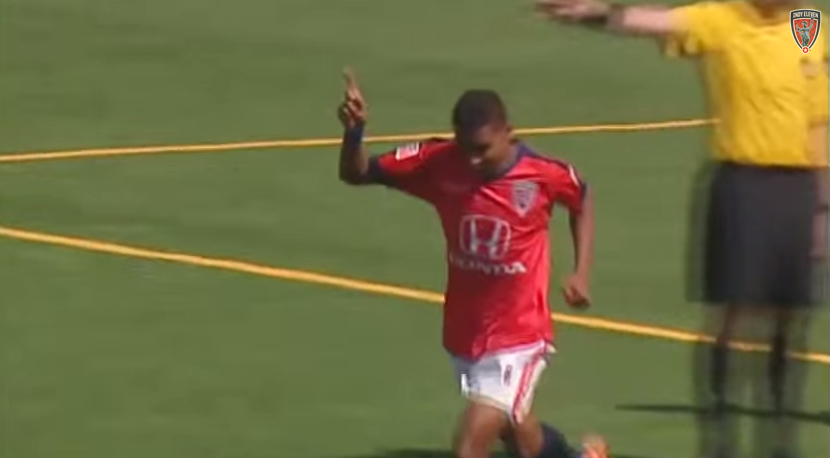
Despite being hobbled by injury, Kléberson proved to be the team's most consistent offensive threat, scoring eight goals in 20 appearances.

Kléberson celebrates after driving a late-game game winner against F.C. Edmonton (also playing its inaugural season in 2014). Despite being hobbled by injury, Kléberson proved to be the team’s most consistent offensive threat in 2014, scoring eight goals in 20 appearances.

Probably embarrassed the organization more with some more four letter words.

“F. yeah! F. yeah! We deserved it! Cheater’s proof! Going back to seven-year-old logic.  Yelling at the fourth official a little, saying, “See!”

That was the first Indy Eleven NASL victory I attended. I wasn’t at the Carolina game. I had the Open Cup at home. This was the first NASL win I’d been at. Celebrated afterwords in a damn-straight way. Hell, yeah! That’s it. Yeah, that was my favorite game.

Rebecca: What was it like: our first home win here, for you?

Peter: It felt like a fait accompli. Not that we would win that game, but at some point, obviously, we knew we’d win a home game. … Whereas the Brickyard Battalion was pumped for a pitch invasion … I watched the end of the game in the Brickyard Battalion, but had no desire whatsoever to have a cathartic rush to the field. The Edmonton game to me was more cathartic and emotional than the Minnesota game. The Minnesota game was more of a sigh of relief.

Rebecca: Taking out No.1 is pretty special right?

Peter: Oh, I was thrilled. But it was more of a quiet, internal moment of Yeah, we did it. An accomplishment; I was really proud and excited.

I was in the last row in the Brickyard Battalion. Watching the pink smoke come up … Brickyard Battalion breast cancer awareness … I watched it all unfold from up there, it was a beautiful sight.

Rebecca: Did it bring tears to the eyes to see so many people so emotional?

Peter: Yeah! I was very proud. It was very rewarding. That was a manifestation of all the work our staff had put in, our players had put in, the coaches, the community. To see them being able to release the pent up energy was fantastic.

The Townsend Family, Clyde, Rebecca and Jasmine, found President Wilt pretty in pink and all smiles post-game on Oct. 11 — his team's first home win in a NASL match.

The Townsend Family, Clyde, Rebecca and Jasmine, found President Wilt pretty in pink and all smiles post-game on Oct. 11 — his team’s first home win in a NASL match.

There were a couple celebrations around town … (but) I didn’t get out of the stadium until 1 a.m., so I ended up not going to either, but while driving home I saw some Minnesota supporter friends of mine lost, looking for their hotel, so I gave them a ride. Then I went home and the game was just finishing up on television and I watched the end of it and I saw the pitch invasion.

And I got to see more closely via television the celebration, and I saw Kristian Nicht celebrate with his daughters. And I got a little emotional then. [Peter actually breaks up at this point and gets emotional, tears up.] It was more meaningful than if we had won the first game, you know?


Rebecca: I was ready for that first win. And then it hurt more and more throughout the season. Then it got to a point where it was like: This is baloney. We are playing hard enough. We deserve to win. But to have worked through the pain and difficulty of loss, it makes it more valuable. It’s not easy.  Looking forward to 2015: What are the chances of some international travel?

Indy Eleven staff members John Koluder and Guy-Jo Gordon present team scarves to the Madame Minister Lukenge who visited Indiana to, among other things, meet with people involved in the WAZA Alliance educational outreach efforts in the D.R. Congo. (Photo by R. Townsend)

Soccer Diplomacy: Indy Eleven staff members John Koluder and Guy-Jo Gordon present team scarves to the Madame Minister Lukenge who visited Indiana in May to, among other things, meet with people involved in the WAZA Alliance educational outreach efforts in the D.R. Congo. (Photo by R. Townsend)


Peter: I haven’t heard anything from Africa in a while, from the Congo… Not looking good.

TP Mazembe Crest

TP Mazembe’s team crest. Madame Minister Lukenge of Lubumbashi, D.R. Congo, joked that her team’s crocodile would eat Indy Eleven’s canine mascot, Zeke the Zouave.


Moïse Katumbi Mazembe is  governor of D.R. Congo's Katanga Providence. He is also a former fútboler and current owner of the club TP Mazembe. Katumbi has expressed interest in hosting Indy Eleven. The idea has even been bandied about in Indy about an international soccer exposition, though the fact that the city lacks a world-class soccer stadium is an embarrassment on that score. Good 'ole Kuntz Stadium could be retooled...  Should the Eleven play in D.R. Congo they may be the first U.S. club to play on African soil! More exact stats are needed to confirm this assertion.

Moïse Katumbi is governor of D.R. Congo’s Katanga Providence — a current front-runner in an upcoming presidential election. He is also a former fútboler and current owner of the club TP Mazembe, which a Jan. 20 Financial Times article referred to as “one of the best-run football clubs in sub-Saharan Africa.” Katumbi has expressed interest in hosting Indy Eleven. Should the Eleven play in D.R. Congo, they may be the first U.S. club to play on African soil, though more exact stats are needed to confirm this assertion.

Rebecca: About the stadium, how do you get the necessary buy-in?

Peter: Education. Whether it’s the legislators or the public, the media. It’s just educating, so they don’t take things at the surface level of pre-existing concepts of what stadium asks are often about. If they take the time and we do a good enough of a job of educating and teaching them about what we’re proposing, we’ll be fine.

Rebecca: Let’s review the basic points: Is this a tax increase or not?

Peter: It will not be a tax increase. We’re already charging a 10 percent facility fee on our games on our tickets. So that money would just go to pay off to  paying off the debt service. That would be true for all the events held at our stadium.

Rebecca: So the Marion County Capital Improvement Board would issue a bond on your behalf and you’d pay it with fees charged to ticket, refreshments and gear?

Peter: Yes, and there’s other revenues that go in including income taxes from our athletes and the employees that work at the stadium and that sort of thing.

Rebecca: Is there any way the taxpayer can get screwed on this deal?

Peter: I’m the president of a soccer team, so that’s a better question for financial experts.

Rebecca: What’s the cost again?

Peter: $87 million — about 12 percent of what Lucas Oil Stadium was 10 years ago.

Rebecca: How many fields do we get for that?

Peter: To be determined. Certainly, obviously, the stadium field. I think if there would be practice fields in additional to that, we’d pay for them privately.

Rebecca: Are we certain this will be a grass field?

Peter: No. I think it’s very likely it would be.

Rebecca: Well, President Wilt, that will do for now. [BTW — It better DAMN WELL be grass.]

Editor’s note: For continued news on the quest for an Indy Eleven stadium, stay tuned to Hoosier Shangrila.