
By Rebecca Townsend
INDIANAPOLIS — One of the most delightful and unusual events of my ongoing home detention came as I found myself sitting in my study across from legendary soccer coach Anson Dorrance — hands down one of my top soccer role models. (If only I could have played for that guy. Or had him give me some instruction or encouragement in my youth …)
Ah, but as the late 80s faded, while I was busy taking on all the boys in Bloomington as a 12-year-old tomboy, Coach Dorrance was pulling together young females who could basically coach themselves into a squad. The team could only afford to train together for one week before playing in the world championships as the first U.S. Women’s National Team, so they needed intrinsically driven athletes. It was humbling for me (thinking I was such a tough chick) to enter the 90s and begin to become aware of this girl who shared so many characteristics with me — but in some amazingly trained super form. That girl was Mia Hamm, who became my number one soccer hero/shero, closely followed by the rest of those early teams and the man who coached so many of them internationally and at the University of North Carolina where he has coached the women’s team since 1979, amassing an unmatched win rate of over .900.
So there I am, nearly 30 years later, fireside in a cozy barrel chair across from Anson, who was on my phone, video chatting live from his North Carolina home as a contributor to United Soccer Coaches’ Coaching Through Covid series. The day’s topic was “Keeping it Positive in an Unpredictable World” and Anson was joined with a long-time colleague, Dr. Colleen Hacker, former U.S. Womens National Team Mental Skills Coach. Soccer broadcaster Dean Linke hosted. It felt so intimate, but in reality, I was in an audience of 1,500 people tuned in from all over the place.
Here are some elements of the conversation that stuck out to me. Please forgive me (and let me know) if, in condensing and weaving together these words, I’ve somehow lost or adulterated their original meaning.
On a Positive Note
On the subject of positivity, Colleen Hacker advised her audience not to confuse being positive with being a fanciful pollyanna. Positivity has direction; it is literally charged. Hacker sees coaches setting the stage for positive change when they practice the three “P”s: 1) meeting players/colleagues on a personal level, 2) aiming to be productive and 3) purposeful.
“We coach people. Not soccer. We’re coaching people who play soccer,” Hacker said. “Sixty-five percent of your success is going to be about relationships.”
The skills that separate good from great players are 1) intrinsic motivation and 2) mental toughness, Hacker noted, citing psychologist Martin Seligman, whose theories of learned optimism and learned helplessness promote positivity and wellness. “These are controllable factors,” she said. “Mental toughness is not an inborn trait, it’s a skill that improves when targeted.”
For 40 years Hacker has been breaking down the came into a 4+1 system: Technical + Tactical + Psychological + Physical (+ Teamwork). Each of those four aspects can be strengthened individually. So, she said, “Get to Work!”
In their own ways, both speakers asked: Do we as coaches and players want to be people who make excuses or people take care of business?
At 69 years old, Anson has a torn labrum in his hip, his knee can bum out, he has slipped disks “and I still love to play,” he said. “If you love the game, you stay involved with it. You’ll find your game.”
The Fitness Test
Boxers have a saying: You don’t get ready, you stay ready.
The same holds true if you show up to play for Anson Dorrance.
During the early days of the U.S. National Team, he needed players with the discipline to train on their own. He told them to arrive at training camp fit. The one girl who failed the test was sent home immediately. The legend of that unfortunate player has cemented the culture for that team: no young woman has ever failed the fitness test again.
Coaches can inspire their players to stay ready right now by advising them to Control the Controllables (CTC). “You can control your effort and your attitude,” Hacker said. “I’m spending a lot of time trying to control the controllables. Be where your feet are: in the now.”
Other controllables include: how long, how well, how hard you work out; how much time you take to rest and sleep; what you do to ensure quality sleep; the nutrient quality of what we put in our bodies; how well we stay hydrated.
During this time of separation, “focus on what you can do: fitness, wellness, mentality,” Dorrance said, noting even a 1% improvement is an improvement.
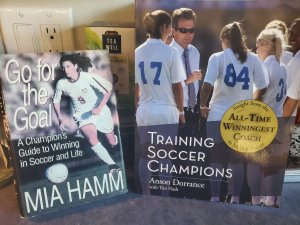
These two books are mainstays in my soccer library! My players still hear about the Pelé series Mia describes in her book.
Get Hooked on Books
An author in his own right, Coach Dorrance said, “So much of my inspiration comes from books.” *
His team leadership council is intimately familiar with concentration camp survivor Viktor Frankl’s Man’s Search for Meaning, in which the power of positive thinking is tested in the face of death and cruelty. If Frankl could use positivity to inspire strength and hope, even as everything he loved in life was murdered, any of us should be able to muster some optimism, Dorrance suggested.
“You can control your attitude in any situation,” he said. “It’s the last of the human freedoms. It’s a choice you get to make every morning when you wake up…. Every champion player is a reflection of choices they make every morning.”
Do you bring passion and joy to the game as a player, as a coach?
Hacker, also an author, referred to a study comparing a group of kids who colored for rewards with a group that colored for fun. The kids who colored for rewards did not color on their own in free time, whereas those who colored for fun would. Colleen extrapolated the idea for soccer: “If the only reason you’re working on 1v1 is for my praise: I have a problem, you have a problem and we have a problem,” she said. “Where one finds joy, one can find mastery.”
Like the coaches have been asking of the USWNT since its inception: “What do you do when no one is watching?”
Love drives great players to make tough decisions morning after morning. While others sleep or party, champions are digging deeper within themself to sow the seeds of success.
Hacker references legendary tennis player and feminist icon Billie Jean King and her book Pressure is a Privilege: Lessons I’ve Learned from Life and the Battle of the Sexes.
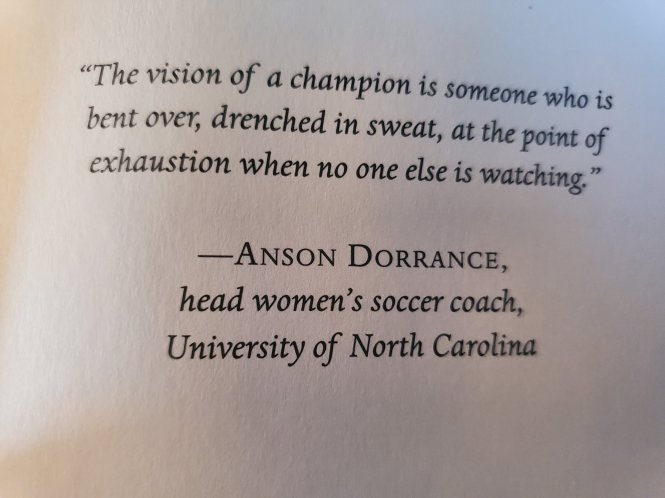
The epigraph of Hamm’s Go For The Goal invokes Dorrance’s vision.
The Vision of a Champion (Spoiler: She’s not wearing a crown.)
Anson talks about Tobin Heath nutmegging him a million times — “along with every other coach she’s had.” Those nutmegs illustrate Tobin’s pure love of the ball. She derives joy from a good nutmeg.
While joy is essential to building a great game, individual drive sets great players apart.
One early morning, Coach Dorrance was surprised to find Mia Hamm at a city park doing sprints, unaware of his presence, simply training for training’s sake. He wrote her a note, acknowledging and appreciating her work ethic. “I knew she was going to ascend,” he said. Years later, Mia Hamm published a book called Go for the Goal. She sent him a copy with his note tucked under the cover.
Watching Hamm hunched over, out of breath, covered in sweat without any awareness that she was being watched, that scene will endure forever in her coach’s mind as his “vision of a champion.”
Growth is what we desire as players and coaches, correct? Yes, Even know when we may feel as if we are in suspended animation.
“Do today well. Do now well,” Hacker said, noting that while a person can’t control the future or the past, if one can make tough, difficult decisions, even in little increments, “you will grow.”
As we coach through COVID, Hacker encourages us to remember, “We’re not just trying to get through this, we’re trying to grow through this.”
Staying Positive and other episodes in the “Coaching Through Covid” series are archived at unitedsoccercoaches.org/coaching-through-covid/. The series home page also has a schedule of future sessions along with registration information.
* Training Soccer Champions by Anson Dorrance and Tim Nash.
* * Catch Them Being Good: Everything You Need to Know to Successfully Coach Girls by Charles Salzberg, Colleen Hacker, and Tony DiCicco.
* * *
 Hoosier Shangrila